

🗺️Map Your AI Opportunities: An atlas for people who 'think for a living'
A practical framework (and template prompts) for individuals, teams and leaders to map out where generative AI could help them do more

Welcome Pioneers! Jagged Pioneers is a newsletter mapping the ways that generative AI can boost productivity, creativity, learning and well-being across knowledge and creative work. It’s written by me, Jack Orlik, an innovation advisor, in a personal capacity. To keep charting these mysterious and shifting frontiers, please subscribe.

⛰️The Landscape of AI Opportunities
The landscape of AI possibilities is ever-changing and largely unexplored. While most people are huddled around familiar landmarks - using large language models like ChatGPT and Claude AI for basic tasks like text editing - those who create their own map of AI opportunities will quickly discover more valuable uses.
Recent studies show how people tend to cluster around obvious uses for AI. The Australian Government found that most of their staff with access to MS Copilot were using it for tasks like text summarisation and needed more training than expected. As the Wharton entrepreneurship professor turned tireless AI sherpa Ethan Mollick has pointed out, doctors in another study used ChatGPT in the same way as they would a search engine - asking simple questions rather than using the tool’s ability to respond comprehensively to more in-depth requests.
This is partly an issue of technique. Many of us are still learning to dance with generative AI - how to lead it, when to follow, and how to avoid being tripped up by its missteps. But it is also the result of a lack of clarity about where AI could add value to the work of an individual, team or organisation.
Perhaps this isn’t surprising. Tools like ChatGPT and Claude haven’t been around for long. The ‘jagged frontier’ that defines the edge of AI capabilities isn’t just unmapped, it changes with every new update. Information about how AI can be used is often in areas of the internet that most people aren’t aware of, like the academic pre-print site arxiv or the blogs of AI labs. The areas that people do visit, like social media, are swamped with AI hype, AI hate and technical jargon.
When we do come across inspiring or valuable applications of AI, integrating them into our own workflows can be challenging. Real-life tasks or situations where AI can add value (or ‘use-cases’) are often highly specific to practices within a particular team, or even to an individual.
So how can individuals, teams and organisations begin to identify opportunities for using AI in their own work?
I’ve created a simple framework to help you map out use-cases by thinking through two different dimensions: Activities and Outcomes. Think of it as your AI cartographer's toolkit - helping you spot not just the obvious landmarks, but the hidden paths and unexplored peaks where AI could transform your work. And if you want to jump straight in and take your AI for a spin, I’ve included template prompts in the footnotes.
Dimension 1: Activities where AI can help
Knowledge work (any job where a person has to ‘think for a living’, including scientists, designers, writers) typically involves three core types of activities: knowledge processing, creativity, learning. Generative AI shows potential in each of these areas.
1. 📊 Knowledge processing
This includes gathering, comparing, analysing and formatting information. To keep the mapping framework simple (though I may review this), I’d also include activities like planning, which require people to use knowledge to define goals and anticipate future opportunities and challenges. Large language models are already recognised for the role they can play in these types of activities. In the pilot study of Microsoft Copilot for Australian government workers mentioned earlier, workers saved up to 1.1 hours a day on tasks like summarisation, preparation of meeting minutes and preparing document first drafts. See the footnotes for a suggested prompt to develop a project plan1.
2.🖋️ Creativity
Including coming up with ideas, drafting texts, designing innovative approaches to solve problems. Creativity is a contentious area for AI to play, as definitions of creativity are slippery and everyone’s a critic. Yet when coming up with ideas and writing in interesting and innovative ways, people using large language models have been judged ‘more creative’ and able to generate more and better ideas than most humans working without these AI tools. Their ability to generate dozens of ideas (even if 80% are terrible) and inexhaustible patience makes them useful for brainstorming, reframing, content variation and iteration. Have fun with them! See the footnotes for a suggested prompt to help reframe a problem and generate ideas2.
3.🧩 Learning
This encompasses activities to find answers to questions, develop knowledge and skills, and improve practices and processes through monitoring and adaptation. Using tools like ChatGPT in educational contexts is controversial3, and there have been a studies showing that they can damage students’ ability to learn4. Yet with well-designed interactions and critical, conscious use, they can accelerate and support learning through tailored practice. See the footnotes for a suggested prompt to help you learn about new concepts5.
These categories are not discrete. In practice, they overlap. Writing a persuasive email, for instance, requires a person to present knowledge and information in an accessible and useful way, engage their creative mind to make it compelling, and is likely to be based on prior learning about the context and needs of the recipient. They’re also unlikely to be totally comprehensive. I’ve been wondering whether activities like communication or planning are worth putting in their own categories - let me know what you think.
Dimension 2: Outcomes for AI use
This dimension is inspired by Azeem Azhar’s newsletter from August 2024, ‘What bosses miss about generative AI’ (Paid). Azhar observes three levels of generative AI use in organisations:
“Level 1: Do what we do cheaper.
Level 2: Do what we do, just do it better.
Level 3: Do entirely new things.”
He points out that most are ‘stuck on level 1 or 2’, focusing on cost savings or improvements as desired outcomes. Yet generative AI has the potential to unlock activities or outputs that would previously have been too difficult or expensive to even consider.
Generative AI can help process knowledge in new ways by connecting disciplines and theories in novel ways, help people explore the creative possibilities of combining different ideas or styles, and it can support continuous learning within organisations by helping individuals and teams to gather and make sense of information they generate through their interactions with others.
Making space for yourself and your team to think imaginatively about Level 3 - and how innovations in this area could either expand or disrupt your capabilities - is important. It could be existential: How might a new player operating at Level 3 disrupt your sector or field?
📍Bringing it all together: 9 opportunity areas for generative AI use
When we combine these dimensions - Activities and Outcomes - we get nine distinct areas of opportunity for AI implementation. Voilà.
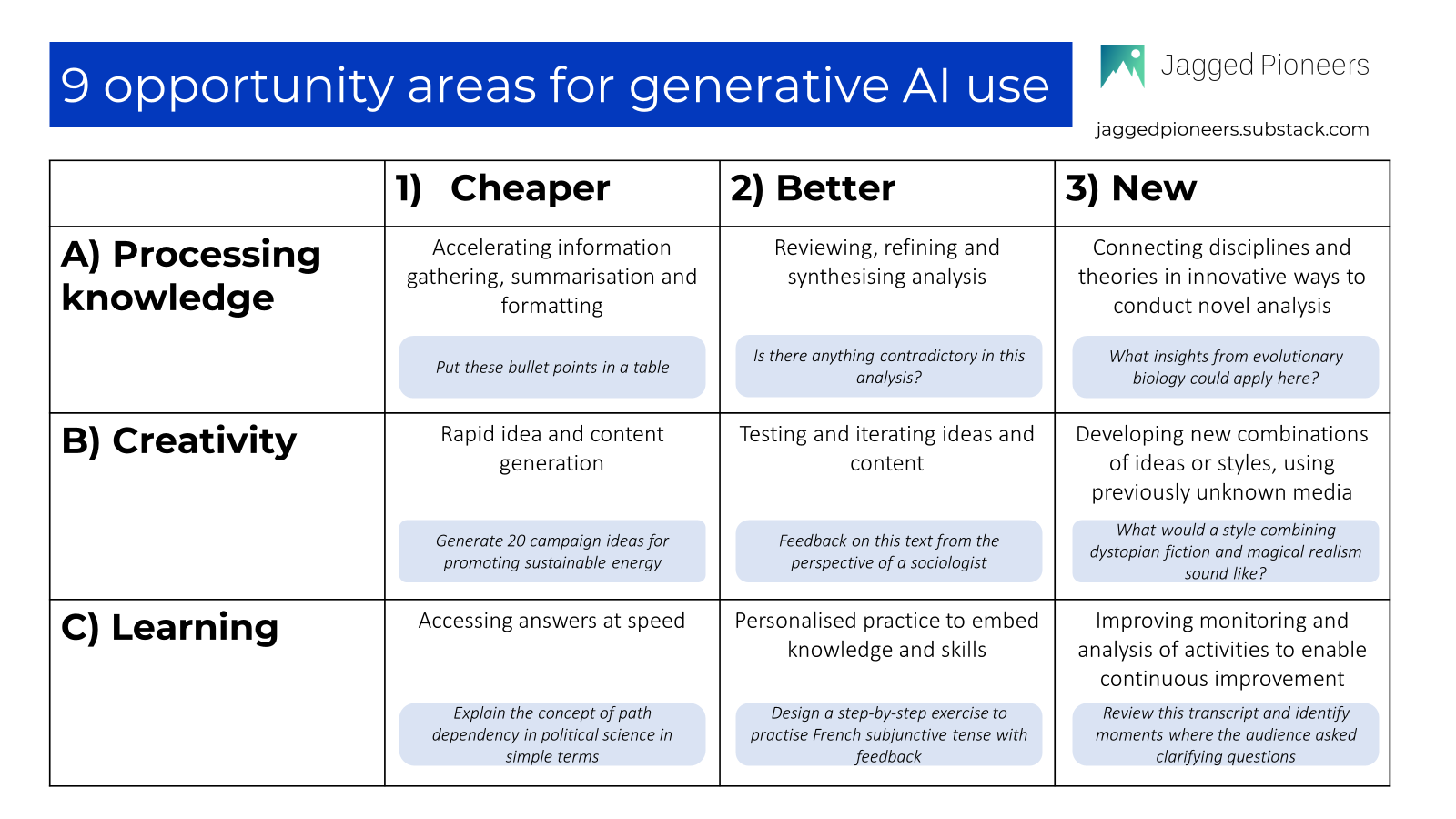
Each of these squares highlights an area where AI could enhance your work, with suggestions for activities and prompts. The framework isn’t just theoretical. When I use it as a provocation in workshops6 , teams are quickly able to map out potential high-impact applications across most of these areas.
Next steps: Map Your AI Opportunities
Here are three practical steps you can take as a team or individual to explore how AI might transform your work:
Map your current activities: Use the activity framework to help list and categorise tasks that could be supported with generative AI. Which activities fall under knowledge processing, creativity or learning?
Identify quick wins: Look for Level 1 and Level 2 opportunities where AI could help you work more efficiently and effectively. Discuss who could test these, and how they would assess the effectiveness of applying AI.
Explore innovation opportunities: Set aside time to brainstorm Level 3 possibilities. What new services could you offer? What complex problems could you tackle differently? What emerging ideas could you test?
This might seem like a big ask as the year comes to a close. Scheduling time for these activities in January, when we’re all more open to change, could help you spot some big opportunities (and challenges) and set out practical steps to enhance your work with AI in 2025.
The goal here isn’t to replace you in your work but to find new ways in which your abilities can be augmented and extended. The framework helps you to identify areas where you could experiment with AI, making sure to think critically about the impact you’d like to achieve and evaluate its effects on efficiency, quality and personal development.
Become a Jagged Pioneer!
I’d love to hear how you might apply this framework. Share your thoughts or experiences in the comments.
Share this post with other Jagged Pioneers, and subscribe to stay updated on future newsletters about:
Strategies and techniques for managing AI dependency risks
Structuring organisations to foster effective AI exploration and implementation
Updates to this framework based on reader feedback and new research
Prompt: Project planning
Help me develop a comprehensive project plan. You are a strategic thinker with exceptional knowledge of a range of different approaches to project planning, such as PRINCE2.
Context: [describe project, providing as much detail as possible].
Interview me, asking one question at a time, to build context and address gaps in the information I have provided. You may ask up to 10 multiple-choice questions, using your knowledge of the field and approach to ask valuable, incisive questions.
Once you have finished with your interview, ask me if I am ready for you to produce the plan.
Then produce the plan:
1. Identify key workstreams and dependencies
2. Suggest potential risks and mitigation strategies 3. Propose success metrics and monitoring approaches
4. Identify critical stakeholders and their interests
5. Suggest innovative approaches we might not have considered.
Break this down into phases and provide specific action items for each.
Prompt: Creative problem-solving
Help me reframe a problem and come up with innovative solutions. We're facing this challenge: [describe problem, giving as much detail as possible].
Interview me, asking just one question at a time, to build context and address gaps in the information I have provided. You may ask up to 10 multiple-choice questions, using your knowledge of the field and approach to ask valuable, incisive questions.
Once you have finished with your interview, ask me if I am ready for you to reframe the problem and identify solutions.
Then, please:
1. Reframe this problem from 5 different perspectives (e.g., customer, competitor, partner)
2. For each perspective, suggest 5 innovative approaches to solving it
3. Identify any hidden opportunities in each approach.
Be bold with suggestions while maintaining practical feasibility.
I highly recommend this point-by-point riposte to OpenAI’s recent ‘Student’s Guide to Writing with ChatGPT’ by French academic Arthur Perret: https://www.arthurperret.fr/blog/2024-11-14-student-guide-not-writing-with-chatgpt.html
⚠️ Beware of AI dependency⚠️
Using AI risks dependency and skill erosion. In the area of knowledge processing, one study found that HR professionals became less accurate in their assessments of candidates when using an AI tool. In creativity, users of LLMs were found to produce more homogeneous ideas and struggle to be creative when they didn’t have access to their AI tool. In learning, students who used ChatGPT to find answers while learning did worse in an unassisted exam.
I’ll explore the risks of AI dependency and how to mitigate them in a later post. In the meantime, go easy on your EBEs (Electronic Brain Enhancements).
Prompt: Learning new concepts
I'm trying to understand [concept]. You are a patient and knowledgeable teacher. Please ask me a 4-5 questions, asking one at a time, to understand why I would like to understand this concept, my background knowledge and experience, and where I might apply this concept. If possible, make these questions multiple choice.
Then, ask me if I would like you to provide a tailored overview of the concept. Taking my answers to the previous questions into account, please:
Provide a clear summary of the concept and key related actors and topicsExplain it using 3 different analogiesProvide real-world examplesCreate a simple framework for remembering key pointsHighlight common misconceptions
Then, ask me questions to test my understanding. Please provide clear in-line references and citations so that I can check your work.
I’m delivering a generative AI workshop to teams in a variety of functions - including translation, audit, finance and communications and will be putting together a more comprehensive curriculum in the new year. Get in touch if you’d like to talk about this.